Aug 12, 2026
When a child has experienced something difficult, parents often find themselves caught between two thoughts:
I know my child might benefit from therapy.
And:
I’m worried about what therapy will ask them to revisit.
For parents searching for play therapy in Barrie, one of the most common questions isn’t simply whether therapy can help. It’s what actually happens once their child walks through the door.
Will they be expected to sit on a couch and talk about what happened? Will the therapist ask direct questions about experiences they aren’t ready to discuss? What if they don’t have the words to explain how they’re feeling?
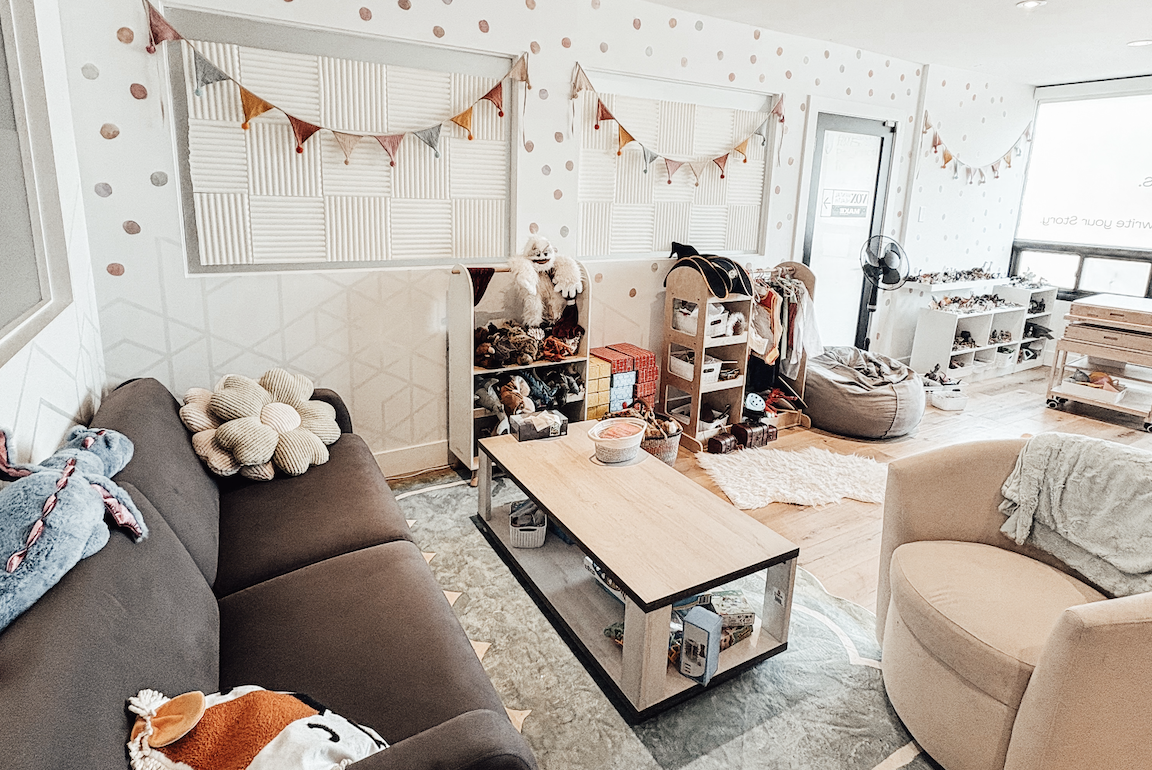
At VOX Mental Health in Barrie, Ontario, our play therapy space looks very different from what many people picture when they imagine traditional psychotherapy.There are sand trays and hundreds of miniature figures. Art supplies. Games. Toys. Sensory materials. Dollhouses and imaginative worlds waiting to be built.
To a child, it may look like a room designed for play. Clinically, there is much more happening.
Adults tend to process experiences through language. We tell stories, describe emotions, make connections between the past and present, and reflect on why we responded in a particular way. Children are still developing those abilities.
A child may know that their stomach hurts before school without being able to explain that they feel anxious. They may become angry during transitions without understanding what makes change feel threatening. They may repeatedly create similar scenes with toys without consciously knowing why that particular story feels important.
That is part of what makes play therapy for children different from simply adapting adult talk therapy for a younger person.
Rather than requiring children to communicate exclusively through conversation, play therapy gives them developmentally appropriate ways to explore their internal and external worlds.
Sometimes children talk.
Sometimes they draw.
Sometimes they build.
Sometimes they create stories.
Sometimes they use miniature figures to communicate something they cannot yet put into words.
The therapist learns to listen to more than language.
It can certainly look that way. And that can be one of the strengths of the approach. Play therapy isn't simply providing toys while a therapist observes. It is a specialized therapeutic intervention that requires additional education, supervision and clinical training.
At VOX Mental Health, play therapy is provided by a clinician who has pursued years of additional training through the Canadian Association for Play Therapy (CAPT). The materials within a play therapy room are also intentional.
Different forms of play can create opportunities for children to explore relationships, emotions, boundaries, safety, control, change, problem-solving and experiences from their everyday lives. The therapist isn't looking for a single hidden meaning behind every toy a child chooses.
Instead, the clinician pays attention to the child's communication, patterns, themes, emotional responses and therapeutic process while creating an environment where the child can explore at a pace that is appropriate for them.
One of the most recognizable parts of our Barrie play therapy space is our sand tray collection. Children can choose from miniature people, animals, buildings, vehicles, fantasy characters, natural objects and other figures to create a world within the sand. For some children, the distance provided by miniature figures can make difficult experiences easier to approach.
Instead of saying:
"This is what happens to me."
A child might show:
"This is what happens to this character."
That distinction can matter.
The therapist can remain curious about the world the child has created without forcing the child to identify it as autobiographical or disclose something before they are ready. Sand tray work can also be used to explore and rehearse everyday transitions.
For example, a child who regularly moves between two parents' homes might create two separate worlds and move figures between them. A child struggling with school transitions might represent home on one side of the tray and school on another.
As figures move between those spaces, the therapist can gently reflect on what happens during the transition: what the character might need, where they feel comfortable, what makes the journey difficult, and what could help. The work remains connected to the child's developmental language: play.
This is an important concern for many parents considering trauma therapy for their child. Play therapy does not mean placing a child in a room and immediately asking them to recount the most difficult thing that has happened to them. Trauma-informed therapy considers readiness, regulation, developmental capacity, safety and the therapeutic relationship. Sometimes therapeutic work begins long before a child directly discusses a difficult experience.
Building trust can be therapeutic.
Learning to identify emotions can be therapeutic.
Practising regulation can be therapeutic.
Experiencing predictability and appropriate boundaries within a safe therapeutic relationship can be therapeutic.
A child does not need to arrive at their first appointment ready to tell their entire story.
Families seek child therapy in Barrie for many different reasons. There does not need to be one major traumatic event for a child to benefit from therapeutic support. Depending on the child's individual needs and clinical assessment, play-based therapy may be considered when children are navigating experiences such as:
• anxiety, worries or fears
• grief and loss
• parental separation or divorce
• transitions between households
• family changes or conflict
• medical experiences or illness
• traumatic or frightening experiences
• emotional regulation difficulties
• school-related stress
• friendship and social challenges
• neurodivergence
• developmental trauma
• changes in behaviour following a stressful event
• difficulty communicating emotions
Every child is different. An assessment with a qualified mental health professional helps determine whether play therapy is appropriate and what type of support may best meet the child's needs.
There isn't one universal play therapy session. A therapist may use more structured interventions at certain times and allow the child greater freedom to direct the play at others. A session might include sand tray work, creative activities, games, storytelling, sensory-based activities or imaginative play.
The therapist's role is not to control every moment of the session. Instead, the therapist creates a consistent therapeutic environment, observes and responds to the child's communication, introduces interventions when clinically appropriate, and supports the child in developing new ways of understanding and responding to their experiences. What looks relatively simple from outside the room can involve significant clinical intention.
We put considerable thought into our play therapy space at VOX because the physical environment is part of a child's experience of coming to therapy. For a child who is already nervous about meeting a therapist, walking into a traditional clinical office can feel intimidating. We want children to encounter something different.
A room where they can explore.
A room where there are choices.
A room where communication doesn't have to begin with a difficult conversation.
A room where being a child isn't something they have to leave at the door in order to participate in therapy.
If you're searching for a play therapist in Barrie, it is reasonable to ask about the clinician's training. "Play therapy" and "using play in therapy" are not necessarily the same thing. Parents can ask prospective therapists about their professional designation, specific play therapy education, supervision, experience working with children, approach to parent involvement, and how they determine whether play therapy is appropriate for a particular child.
At VOX Mental Health, we believe parents should understand the care their child is receiving and feel comfortable asking questions about the therapeutic process.
VOX comes from the Latin word for voice. For us, having a voice doesn't always mean speaking.
Sometimes a child's story appears in a picture.
Sometimes it unfolds between two figures in a sand tray.
Sometimes it emerges through a game, a character or an imaginary world.
And sometimes, before any story is told, a child simply needs to discover that therapy can be a place where they feel safe enough to be themselves.
Our play therapy services in Barrie provide children with developmentally appropriate opportunities to communicate, explore emotions and experiences, and build skills with the support of a trained mental health professional.
If you're wondering whether play therapy might be appropriate for your child, you can contact VOX Mental Health in Barrie, Ontario to learn more about our child and play therapy services.
Reclaim your voice. Rewrite your story.