Sep 21, 2026
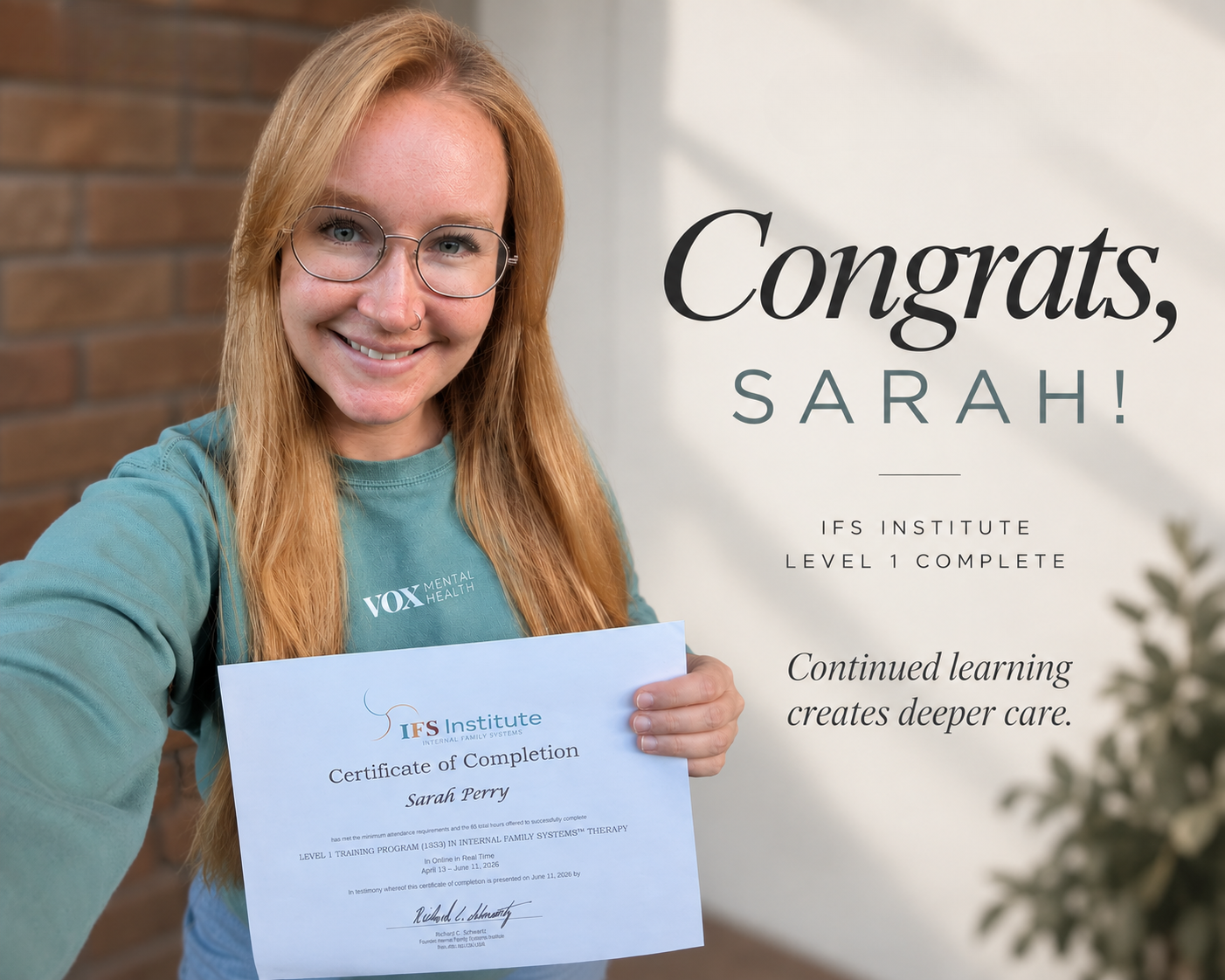
At VOX Mental Health, continuing education is an important part of our commitment to thoughtful, ethical and evidence-informed clinical care. We are incredibly proud to recognize Sarah Perry for completing Level 1 Internal Family Systems (IFS) training through the IFS Institute.
This is a significant professional accomplishment, and one that represents a substantial investment of time, energy and clinical learning.
Internal Family Systems (IFS) is a psychotherapy model developed by Dr. Richard Schwartz that offers a compassionate framework for understanding the different internal “parts” or patterns that can develop within us. Rather than viewing difficult thoughts, emotions or behaviours simply as problems to eliminate, IFS approaches them with curiosity. Many of these responses can be understood as having developed for a reason, .often in an effort to protect us, help us cope or prevent us from experiencing something painful again.
Level 1 training through the IFS Institute is the Institute's foundational professional training in the model. It is designed to help qualified mental health professionals develop both a conceptual understanding of IFS and the clinical skills required to begin integrating the model into their work. And this isn't a weekend workshop.
IFS Institute describes Level 1 as an intensive experiential training of approximately 89–100 hours. Training incorporates teaching, demonstrations, video review, experiential exercises and small-group clinical practice. Cohorts are intentionally limited to a maximum of 36 participants, with a 3:1 student-to-staff ratio.
Completing Level 1 is particularly meaningful because access to the training itself is limited. For Level 1 trainings in Canada and the United States, IFS Institute restricts admission to qualified and legally credentialed mental health professionals. Prospective participants must apply and be approved before entering the applicant pool, and approval does not guarantee an immediate opportunity to register; invitations depend on available training spaces.
That combination of professional eligibility requirements, small training cohorts and significant demand makes completing the program an accomplishment worth recognizing.
For Sarah, it also represents many hours spent outside of her regular clinical responsibilities developing and practising an additional therapeutic framework that she can bring thoughtfully into her work.
One of the strengths of advanced psychotherapy training is that it gives clinicians additional ways of understanding what may be happening beneath a client's presenting concern. Someone may come to therapy wanting help with anxiety, shame, perfectionism, relationship patterns, trauma, self-criticism or feeling stuck in behaviours they intellectually understand but continue to repeat.
IFS provides another lens through which those experiences can be explored. For example, a highly self-critical part may have developed around a belief that criticism prevents failure. A part that avoids vulnerability may have learned that closeness can lead to hurt. A part that becomes intensely anxious may be attempting to anticipate danger before it arrives.
The goal is not to assume that every behaviour has the same explanation. Instead, IFS gives therapists a structured way to approach internal experiences with curiosity and compassion while helping clients better understand the functions those patterns may serve.
Sarah's Level 1 training adds these concepts and interventions to an already developing therapeutic toolbox, giving her additional ways of conceptualizing and supporting the people who trust her with their stories.
A graduate degree and professional registration establish an important foundation for psychotherapy practice. They are not where professional learning ends. As Registered Social Workers, our clinicians are responsible for maintaining professional competence throughout their careers. At VOX, we take that responsibility seriously.
We encourage our clinicians to pursue substantive training in the areas in which they practise, participate in consultation and supervision where appropriate, remain engaged with developments within the profession, and continually examine how their clinical knowledge translates into the care they provide.
Sarah's completion of IFS Institute Level 1 is an excellent example of that commitment. It represents 89–100 hours of intensive professional learning, experiential practice and skill development in a psychotherapy model that can offer clients another meaningful way of understanding themselves.
Most importantly, Sarah didn't undertake this training simply to add another credential to her biography. Advanced training matters because of what happens after the certificate is earned: a clinician returns to the therapy room with additional knowledge, additional clinical language and additional tools for meeting clients where they are.
We are incredibly proud of Sarah for making this investment in her clinical development and excited to see how she continues to integrate this learning into her work at VOX. Congratulations, Sarah. This is a tremendous accomplishment, and very well deserved.